Description
About Tillandsia hildae
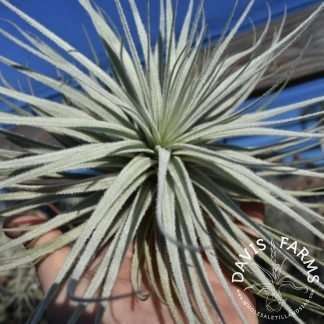
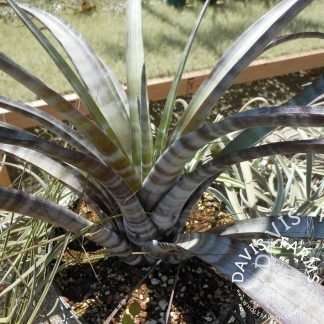
Tillandsia hildae is one of the most distinctive plants in the genus, and nothing else looks quite like it. The leaves carry horizontal bands of silver against darker green, running the full length of the blade. The effect is close to zebra striping.
It comes from the dry Marañón valley in northern Peru, where it grows on steep rock in fierce light. That habitat explains both the banding and the toughness.
This is also a genuine giant. Mature plants reach three feet or more, and the flower spike adds substantially to that. Few Tillandsias make a bigger statement.
We offer several sizes, from small starters through to specimens. The banding grows stronger as the plant matures, so larger plants show the pattern best.
Growing Tillandsia hildae: Care Guide
Tillandsia hildae is firmly xeric. Therefore high light and restraint with water are what it needs.
- Light: As much bright light as you can give it. The silver banding sharpens in strong light and fades to a dull green in shade.
- Water: Soak 20 to 30 minutes every 10 to 14 days. It tolerates drought far better than overwatering.
- Drying: Invert and shake after soaking. The upright leaf bases hold water against the stem.
- Airflow: Good airflow at all times, and especially after watering.
- Temperature: Comfortable from 55°F to 100°F. It handles heat very well. No frost.
- Feeding: Feed monthly through spring and summer with diluted TillyBoost Fertilizer. Growth is slow, so feeding is how you speed it up.
- Mounting: No soil. Large plants need solid mounting on wood or rock, and heavy specimens must be wired.
- Growth rate: Slow, even by Tillandsia standards. A large hildae represents many years, and it should be priced accordingly.
See our Air Plant Care page for fundamentals, and our Rare Air Plants for more collector species.