Description
About Tillandsia queroensis
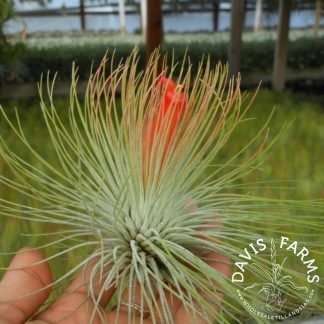
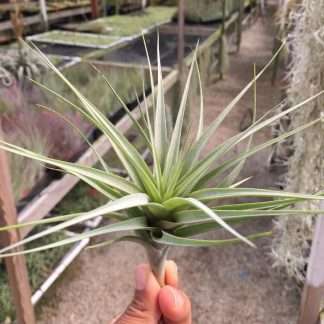
Tillandsia queroensis is a member of the Tillandsia genus. It grows on the eastern Andean slopes of Ecuador and Peru, first collected near Quero, Ecuador, above 8,000 feet. In the wild, it’s a caulescent species that can build a stem over six feet long. It also carries narrow silvery-scaled leaves and a curved, red-bracted inflorescence.
So what we offer is a compact, younger grade at 4-5 inches, well short of that mature habitat scale. But it’s still recognizably the same plant: a tidy silver rosette with the tight, dense scaling that handles bright Andean sun.
It spent decades classified as a variety of a different species before being recognized as its own species in the 1990s. That history is part of why it stays uncommon in cultivation. That rarity is exactly what makes it worth a shelf spot for a buyer serving collectors.
Coming from high-elevation cloud forest, it tolerates cooler, wetter conditions better than most silver Tillandsias. That is a genuine point of difference from desert-adapted species sharing its color.
As it matures and elongates, it rewards patience with a long-lasting, colorful bloom. That makes it worth stocking for buyers willing to grow it on rather than flip it fast.
Growing Tillandsia queroensis: Care Guide
Treat it as mesic, reflecting its humid, high-elevation cloud forest origin. Soak 7-10 days, then invert; it tolerates ambient humidity between soaks better than a xeric plant would.
- Water: Soak 7-10 days, then invert and shake dry.
- Light: Bright, indirect light suits it better than harsh full sun.
- Feeding: Diluted TillyBoost Fertilizer monthly supports steady growth toward its mature form.
- Temperature: Tolerates cooler nights better than most silver species.
- Patience: Grown on, it elongates and blooms; this grade is an early stage.
Feed it TillyBoost Fertilizer through the growing season, and browse more uncommon Andean species in our Rare Air Plants category, or check the air plant care guide for the basics.