Description
About Tillandsia pseudomicans
Tillandsia pseudomicans comes from a specific stretch of Peru: the Apurímac valley between the towns of Andahuaylas and Abancay, at around 2,200 meters elevation. That’s a dry, inter-Andean valley rather than a rainforest, which shapes how the plant is built and how it should be watered.
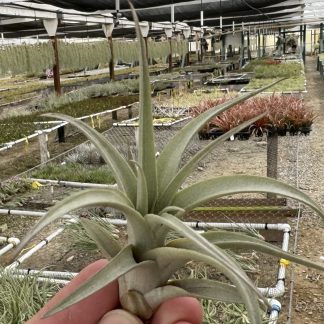
It’s short-caulescent, meaning it grows along a brief visible stem rather than sitting in a tight rosette, reaching about 8 inches tall at flowering. The 10 to 12 leaves are densely grey-scaled and curve downward at the tips, giving the plant a soft, frosted look rather than a glossy green one.
It seldom shows up on wholesale availability lists. That scarcity comes from limited documentation and limited cultivation in the trade, not from any grower secrecy, so a customer who recognizes the name is likely already looking for it specifically.
At bloom, it sends up a flat, simple spike carrying a handful of red flowers with reddish-brown, scaled floral bracts. It’s closely related to Tillandsia micans, but distinguished from it by a smaller stem and red rather than white petals.
It’s a good addition to a specimen case or a “collector’s corner” shelf where the story of a rare, single-valley species carries real weight with the right buyer.
Growing Tillandsia pseudomicans: Care Guide
Because Tillandsia pseudomicans comes from a dry Andean valley, treat it as xeric rather than mesic. Soak it 10-14 days, then invert fully so no water sits in the stem’s leaf bases.
- Water: Soak 10-14 days, then invert and shake dry.
- Light: High light with good airflow, matching its dry-valley origin.
- Feeding: Diluted TillyBoost Fertilizer monthly keeps the caulescent stem growing steadily.
- Grey scaling: The dense grey leaf scales are natural and help the plant handle dry air; avoid wiping them off.
- Bloom: Watch for red flowers on a flat spike, distinguishing it from the white-flowered T. micans.
Keep it on TillyBoost Fertilizer through the season, and browse more collector-grade rarities in our Rare Air Plants category, or read the air plant care guide for soak-and-dry basics. Reference: Tillandsia (no species-specific Wikipedia article exists for pseudomicans; see bromeliad.org.au’s species page for detailed botanical description).