Description
About Tillandsia loliacea
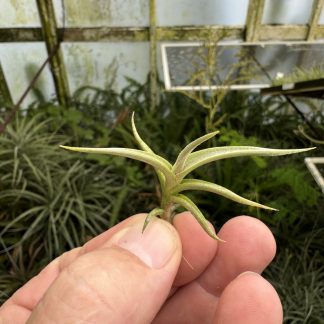
Tillandsia loliacea is one of the miniatures. It belongs to the Diaphoranthema group, the subgenus of tiny air plants with micro, self-pollinating flowers, and it grows to about 1.5 inches tall.
It comes from Bolivia, Paraguay, Brazil and northern Argentina, where it grows on bark and rock in dry forest. The leaves are short, grey and scaly, in a small stemmed rosette.
It clumps and blooms readily. The flowers are tiny and yellow on a thread-like spike, and each one sets a seed pod without any help, so old clumps carry pods and seedlings.
We sell singles at about 1 inch and small clumps about 2 inches wide with multiple pups, plus large and giant clumps.
Loliacea is a terrarium and miniature-display plant, and at $1 it is an easy add to any order. We suggest mounting it on cork and leaving it alone; a clump on a cork slab grows into a mat over the years.
Growing Tillandsia loliacea: Care Guide
Dry lowland forest means bright light, warm days and short rains, and loliacea wants the same on a small scale. Give it bright light with some sun, a quick dip or a thorough misting every week and fast drying, because a plant this small dries in minutes and rots in hours if left wet. Mount it once and do not move it; the roots grip cork well, and a mat that is left undisturbed will seed itself across the slab. It is easily lost among larger plants, so keep it at eye level. Cool nights are fine, and it needs no winter rest to flower.
- Light: Bright light with some direct sun.
- Water: Dip or mist thoroughly every 7 days.
- Drying: Shake. It dries in minutes.
- Airflow: Good airflow always.
- Temperature: 40°F to 95°F. No frost.
- Feeding: Feed monthly with diluted TillyBoost Fertilizer at quarter strength.
- Mounting: Glue to cork and leave it. It seeds itself across the slab.
- Pups: Frequent, plus seedlings. Clumps become mats.
Browse more Air Plants, or read our air plant care guide.