


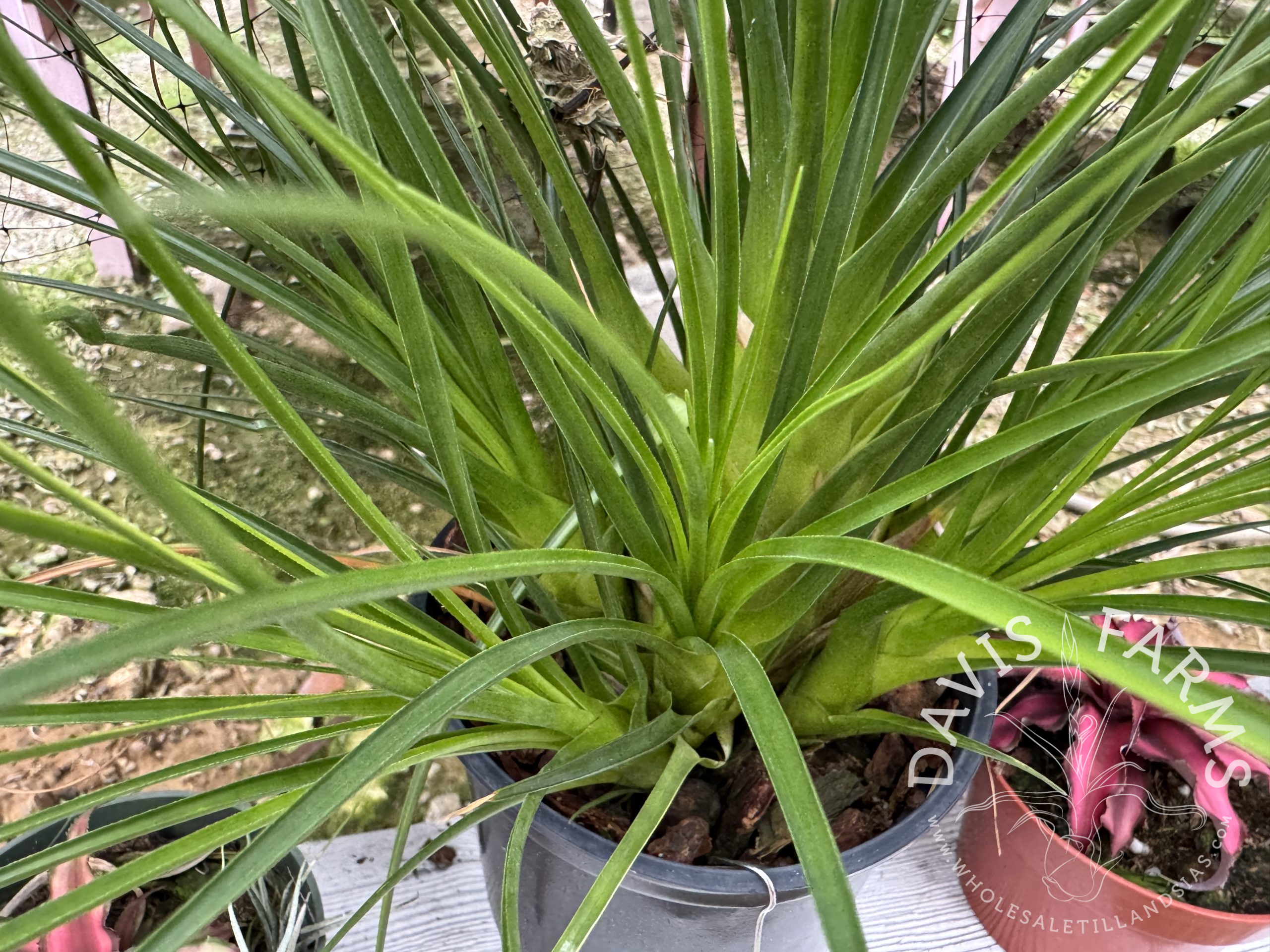
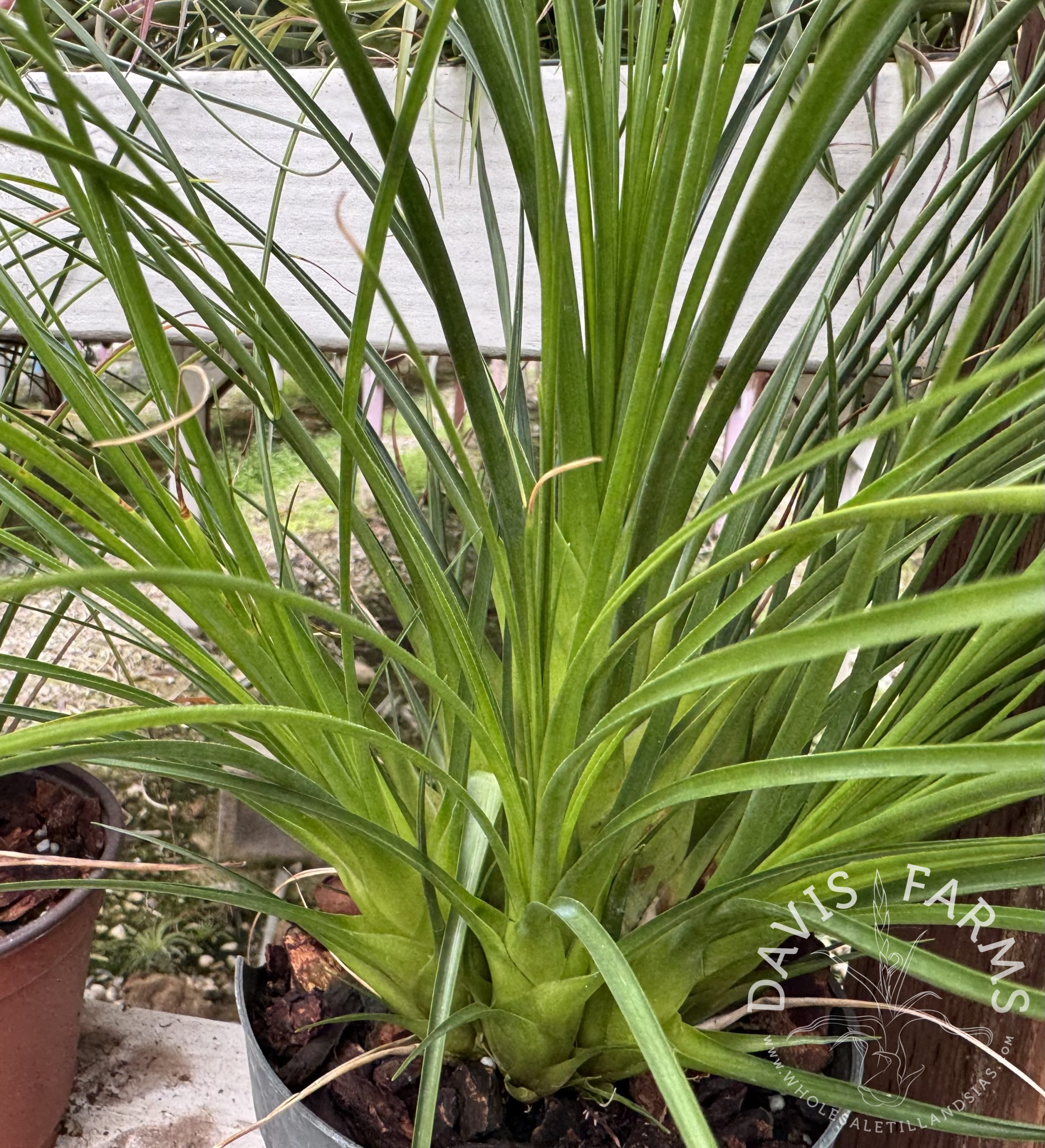

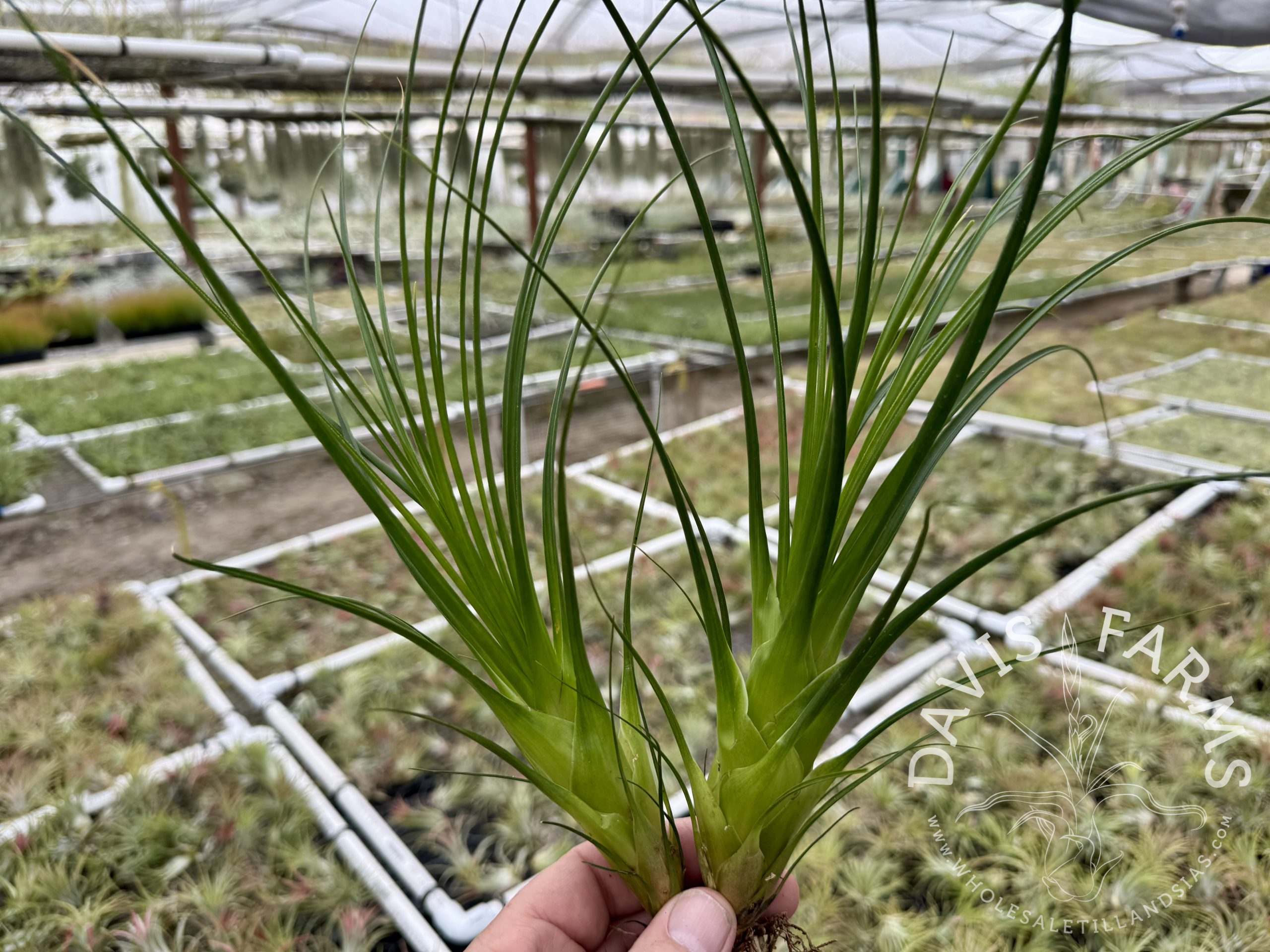
Description
Tillandsia kirchhoffiana is a unique, mesic (moisture-loving) air plant native to the seasonally dry tropical biomes of Mexico, particularly in regions like Veracruz, Puebla, and Oaxaca. It is known for its elegant, grass-like appearance with beautiful black coloration at the base of the leaves.
Physical Characteristics
-
Size & Growth: This is a stemless species that can grow quite large, sometimes reaching up to 1 meter (3.3 feet) in height when in bloom.
-
Foliage: It features a dense, “utriculate” (tank-like) rosette. The leaves are many, linear, and thin at the tips (about 4mm wide), and widen at the base of the plant. It has a deep green color. They typically have dark or purple-colored sheaths at the base as they mature (young plants may not have this).
-
Inflorescence: When it matures, it produces a very lax, spreading inflorescence roughly 50 cm long. The primary bracts are a striking red, while the flowers themselves are tubular and violet or dark blue at the top, sometimes with white bases.
-
Roots: Like most Tillandsias, its roots are primarily used as anchors to attach to tree branches in the wild, rather than for nutrient absorption.
Habitat & Natural Environment
-
Elevation: It is typically found growing as an epiphyte (on trees) at altitudes between 1,200 and 2,000 meters.
-
Environment: Because it is a mesic species, it thrives in environments that are more humid and cooler than those of the silvery, “fuzzy” xeric air plants.
Care & Cultivation
-
Light: Prefers bright, filtered light to semi-shade. It should be protected from hot, direct afternoon sun, which can burn its thin leaves.
-
Watering: Unlike desert-type air plants, T. kirchhoffiana likes to be kept reasonably moist. It benefits from regular misting or soaking (2–3 times a week) and should not be allowed to stay dry for extended periods.
-
Temperature: It enjoys temperate to warm conditions (typically 10–32°C or 50–90°F) but should be protected from frost.
-
Mounting: It can be grown mounted on cork or wood, or even “potted” in an extremely open, bark-based medium, provided it has excellent air circulation to prevent rot at the base.
Note: This species is considered somewhat rare in cultivation and has been reported as potentially extinct in certain parts of its wild range due to habitat loss.


